
Knurrix knowledge
The structure of a tracking trail
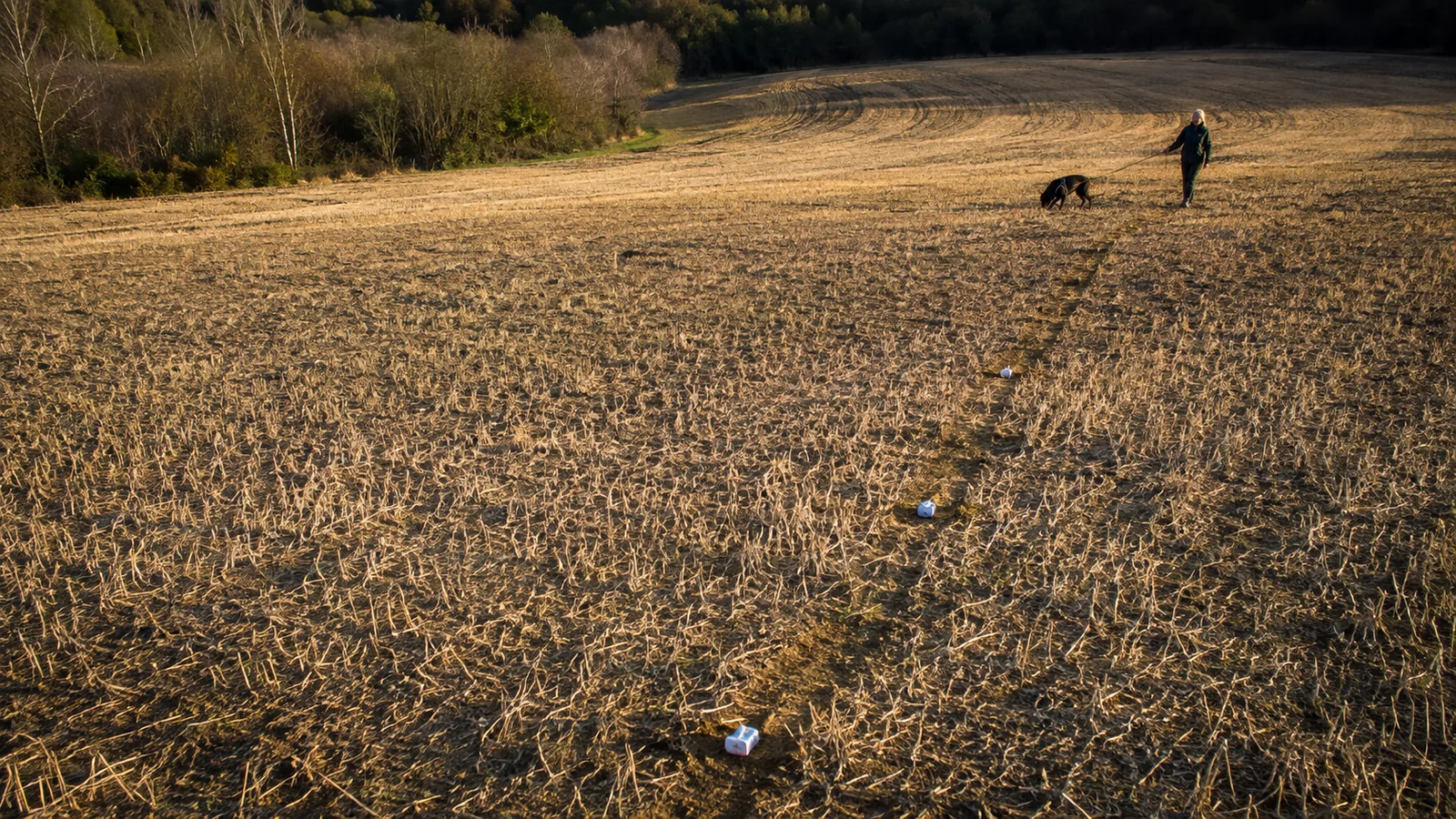
## The scent pad provides the first frame The scent pad is the area in which the trail begins and the dog gathers its first information. In trial-style work it is clearly marked; in training it should be recorded well enough for the handler to find it confidently after the ageing period. Position, the direction of the first leg and, where useful, a photograph of the surroundings prevent a hurried search before the start. A prepared scent pad is not a place for constant commands. The dog should learn to settle, take up the trail and move into the first leg through its own work.
Updated 9 September 2026
Geprüft aus aktiver IGP- und IFH-Fährtenpraxis
In this article
- Legs are the straight sections
- A corner changes direction at a point
- A curve is not an ordinary corner
- Articles lie within the trail
- The finish is part of the planned structure
- Terrain belongs to the structure
- Shared vocabulary improves discussion
- Making the structure clear before laying
- Reviewing the track afterwards
Legs are the straight sections
The mostly straight sections between the scent pad, direction changes and finish are called legs. Their length may be described in paces or metres. Paces are convenient while laying but differ between people; a GPS recording adds a spatial measurement. The number alone does not define difficulty. A long, even leg may be easier than a shorter section containing wheel tracks, a surface change or strong crosswind. Numbering legs makes observations precise. Weeks later, “the dog changed pace on leg four” is still meaningful, whereas “somewhere near the back” is not.
A corner changes direction at a point
A corner is a defined change of direction. It may be right, acute or obtuse and lead left or right. These distinctions matter in training because an acute corner asks for a more pronounced change than an obtuse one. The tracklayer should record the intended type while laying rather than estimate it afterwards from an imprecise map line. GPS points alone cannot classify a corner reliably: measurement uncertainty and stationary clusters can alter the shape. Knurrix links the deliberate marker to the recorded route, while the tracklayer’s training decision remains the authoritative description.
A curve is not an ordinary corner
On a curve, direction changes gradually over a distance. Its beginning and end are separated, unlike a point-like corner. Silently converting a curve into an ordinary corner changes the task being described and makes later review misleading. Curves therefore need to remain their own element in data and display. Their direction, approximate extent and place within the route may be recorded. The aim is not a mathematically perfect arc. It is to preserve the exercise the tracklayer intentionally created so the same task can be recognised and discussed later.
Articles lie within the trail
The tracklayer places articles in their footsteps. Material, size, position and spacing follow the relevant rules in trial-style work and may be varied deliberately in training. The task must remain clear: is the dog expected to indicate or pick up, which response has been trained, and how will the result be recorded? An article immediately at a direction change combines two problems and can obscure the reason for uncertainty. Marking articles while laying allows discovery status, actual indication and the handler’s observation to be added accurately after the track has been worked.
The finish is part of the planned structure
A track does not simply end where a recording stops. The planned finish is an orientation point of its own and should be set deliberately. Depending on the exercise, an article may be placed there or work may end in another clear way. Data should distinguish the intended finish, the end of the laying recording and the end of the worked track. That separation keeps technical interruptions, missed inputs and training structure apart. A complete-looking line is useful, but it cannot replace a conscious record of how the exercise was meant to finish.
Terrain belongs to the structure
Two tracks with the same number of legs and corners may be very different tasks. Slopes, tractor lines, vegetation, surface transitions, paths and field edges affect the work. Wind also meets each leg at a different angle. Structure should therefore never be reviewed without context. Marking significant transitions helps explain why behaviour changed at a particular point. When introducing new geometry, predictable conditions usually make the learning question clearer. If several difficulties change at once, it becomes hard to identify which part produced the response.
Shared vocabulary improves discussion
Scent pad, leg, corner, curve, article and finish are more than labels on a map. They give tracklayers, handlers and trainers a shared vocabulary. Instead of saying that “it became difficult near the end”, a note can state that the dog checked outwards when moving from leg four into a left acute corner and recovered independently. Knurrix links markers and observations to the route. The purpose is not to make every track complicated, but to record its structure clearly enough to support a useful next decision.
Making the structure clear before laying
A small plan is useful before the first step: start area, intended legs, type and direction of each change, articles, terrain transitions and the finish. The actual route may differ in the field; if it does, record what was really laid. Give every leg and directional change an unambiguous number. A later note such as “after corner 2 on leg 3” can then be located precisely. For an arc, mark its beginning and end because the task extends over distance rather than one point. Record article material and position as well. This preparation takes minutes and prevents memory, map lines and the actual construction from being confused after the ageing period.
Reviewing the track afterwards
Begin by checking whether the recorded construction is complete, then look at the worked route and markers together. A deviation near a corner may involve wind, ground, line handling or an imprecise marker, so description should precede judgement. A useful conclusion assigns one next action to each component: keep it, repeat it more simply or increase it deliberately. A well-solved arc might be confirmed while an uncertain article is practised separately. The next track remains understandable, and the dog is not asked to process several corrections at once.