
Knurrix knowledge
What is tracking work with a dog?
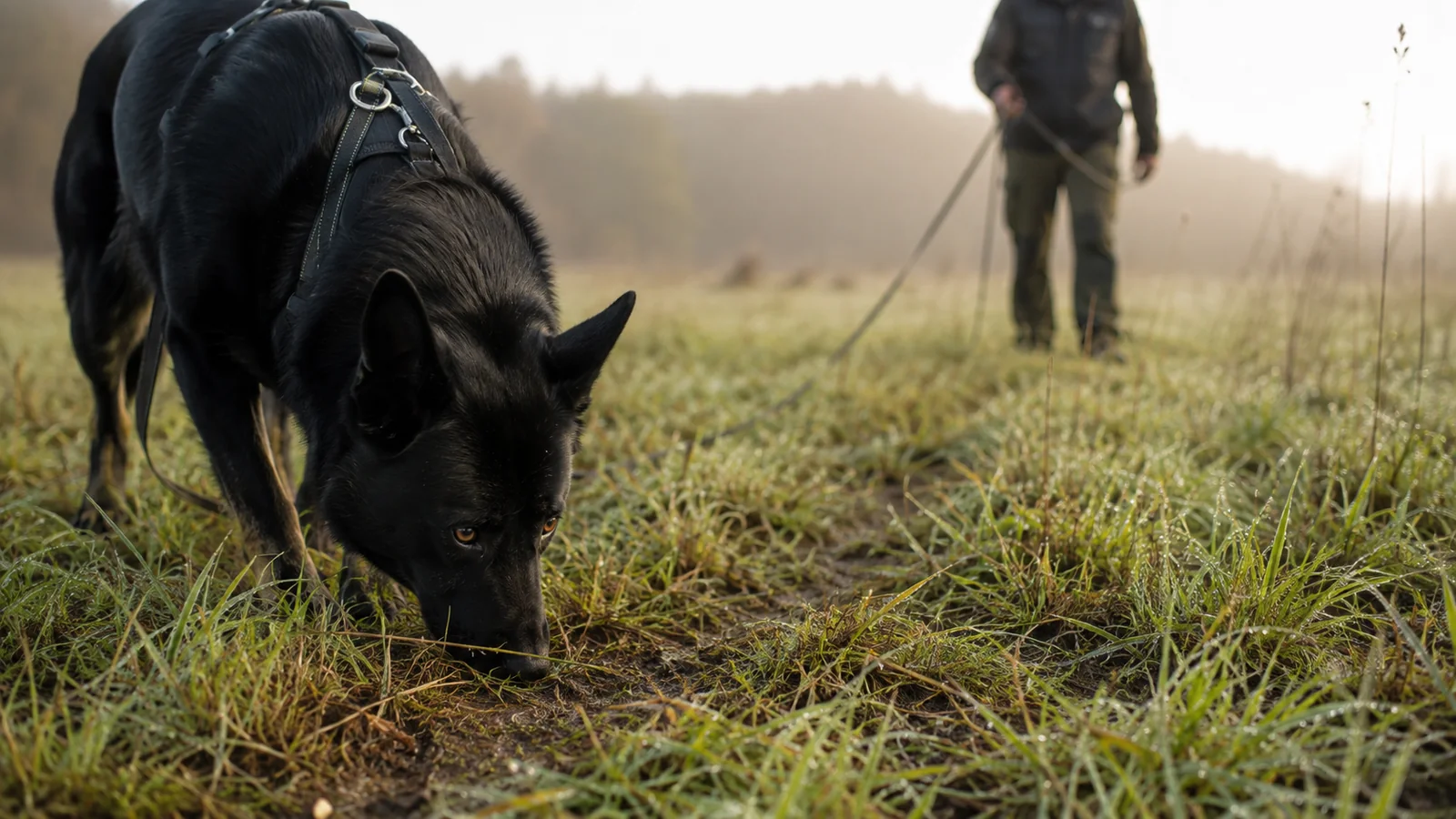
## What tracking work actually involves In tracking work, a dog follows a trail previously laid by a person. The objective is not to reach the end as quickly as possible. Good work appears calm, focused and independent: the dog gathers information at the scent pad, follows the route over distance, negotiates changes of direction and indicates articles. This creates a demanding role for the handler. They must allow the dog to work while reading its behaviour and managing the line without constantly steering. Tracking combines scenting ability with concentration, physical endurance, experience and thoughtful training design.
Updated 9 September 2026
Geprüft aus aktiver IGP- und IFH-Fährtenpraxis
In this article
- A track contains several kinds of information
- Scent pad, legs, direction changes and articles
- The handler’s part in the picture
- Building skill in manageable steps
- Training is not the same as a trial
- Record conditions while laying and working
- What a useful review should achieve
- A practical way to begin
- Common misunderstandings
A track contains several kinds of information
Tracking is often described simply as following footprints. The scent picture in the field is more complex. Footsteps disturb soil and vegetation, the tracklayer leaves individual human scent, and wind, moisture, temperature and cover continue to alter conditions during the ageing period. An observer cannot reliably separate the contribution of every factor for an individual dog at a particular moment. One session should therefore never support a sweeping claim about the dog’s nose. Recording the conditions and comparing several genuinely similar tasks provides a much sounder basis for training decisions.
Scent pad, legs, direction changes and articles
The scent pad forms the starting area. From there, the track follows mostly straight sections known as legs. Direction changes may be defined corners or gradual curves. Articles are placed in the trail for the dog to find and indicate in the trained manner. Each element can be a training task in its own right. A young dog does not need to solve a long ageing time, difficult ground, several acute corners and unfamiliar articles all at once. Effective planning chooses one main question and keeps the rest of the exercise manageable enough for the dog to learn from it.
The handler’s part in the picture
The handler cannot experience the scent picture available to the dog. They can only record visible behaviour: pace, intensity, head position, lateral checking, brief pauses, recovery of the route and responses at articles. Observation should be separated from judgement. “The dog checked two metres left after the second corner and returned without help” is more useful than “the dog lacked focus”. The handler’s own actions also belong in the record. Did the line shorten, did the handler stop, was a verbal cue used, and did the handler know the exact route? Honest detail makes later comparison possible.
Building skill in manageable steps
Training begins with tasks the dog can understand. A clear start, short legs and an obvious article may be the initial priorities. Distance, ageing time, terrain changes, wind, corner types and distractions can then be increased separately. Success does not always mean that a task was too easy, and one mistake does not automatically require a complete restart. Patterns across several sessions matter more. If the dog solves an exercise reliably with a sound working style, one variable can be changed. Repeated uncertainty or substantial help may indicate that the combination was too demanding or insufficiently clear.
Training is not the same as a trial
Training may be designed around one specific ability and does not need to reproduce a complete trial track every time. A trial follows binding requirements for its structure, age, distance, articles and execution. Those requirements can change, so the current rules of the relevant governing body remain the authoritative source. Trial-focused teams benefit from keeping rule requirements and learning objectives distinct. An exercise can be valuable without matching a trial pattern exactly. Conversely, a formally correct layout is not automatically good training if it overwhelms the dog’s current level.
Record conditions while laying and working
Date and distance alone do not explain a session. Useful context includes terrain, surface condition, vegetation, weather, temperature and wind both while the track is laid and while it is worked. Actual track age, line length, unusual disturbances and article positions also matter. These data do not explain behaviour automatically, but they prevent careless comparisons. A short track on dry open soil may present a very different task from the same geometry on damp grass. Knurrix keeps conditions with the laid and worked routes so the review does not depend on memory alone.
What a useful review should achieve
A map or statistic does not grade the dog. It helps the team ask better questions: where did the worked route move away from the laid route, on which leg did pace change, which articles were indicated securely, and did conditions change before the dog started? One answer is not a rule. Repeated, well-documented exercises can reveal patterns worth testing. The most valuable outcome is a specific next step rather than a broad score: retain one task, simplify it, or add one carefully chosen difficulty.
A practical way to begin
A short, clearly laid track on manageable ground is enough for an introductory session. Before laying it, define the aim, approximate length, ageing time and one main focus. After the dog has worked, record visible facts first: where the dog started confidently, where it checked sideways, what help was given and how it indicated the article. Interpretation comes afterwards. This creates a useful basis for the next session instead of a judgement based on memory. New handlers benefit from support by an experienced trainer or club member. Videos and maps can inform that conversation, but they cannot replace seeing the dog, line handling and terrain in person.
Common misunderstandings
A search route that sits exactly on a drawn line is not automatically evidence of good nose work. GPS has measurement uncertainty, scent can move, and the dog is solving an olfactory problem rather than following a navigation line. Speed alone is not a quality measure either: fast work may be superficial, while slow work may be thorough or uncertain. One demanding track cannot establish a permanent level of ability. Records become more meaningful when similar tasks are repeated and deviations are documented honestly. The purpose is not to grade every movement, but to plan fair training and identify patterns without treating a technical measurement as the whole truth about the dog.