
Knurrix knowledge
Indicating articles on the track
## Name direction changes precisely Tracks change direction through corners and curves. “Direction change” alone is often too vague for a useful review. Right, acute and obtuse corners create different geometry, while a curve spreads the change over distance. The tracklayer knows the intended exercise and should mark it at the time of laying. A GPS line can support that information but cannot infer it reliably. Measurement uncertainty, stationary points and uneven pacing alter the visible shape. Knurrix therefore keeps the deliberate training marker separate from the technical route.
Updated 9 September 2026
Geprüft aus aktiver IGP- und IFH-Fährtenpraxis
In this article
- Right, acute and obtuse corners
- Curves remain their own element
- Articles require a clear training idea
- Discovery and indication are separate observations
- Placement changes difficulty
- Avoid misleading records
- Turn observations into one next step
- Training changes of direction deliberately
- Observing without rushing to judgement
- A short documentation routine
Right, acute and obtuse corners
A right corner changes direction by roughly ninety degrees. An acute corner turns back more sharply, whereas an obtuse corner leads into a shallower new direction. Left and right should also be recorded. Dogs may show different strategies by direction, and terrain or wind can strengthen that impression. One uncertain corner does not prove a lasting weakness. Repeated records from genuinely similar exercises help distinguish a pattern from a response to the conditions of one day.
Curves remain their own element
On a curve, direction changes step by step. The start and finish are separated and the trail follows a bent course between them. Reducing that course to a point-like corner removes the original training information. A dog may work a long curve differently from a defined corner. Data and maps should therefore preserve curves as curves, including direction and approximate extent where useful. The aim is not mathematical perfection but faithful description of the exercise.
Articles require a clear training idea
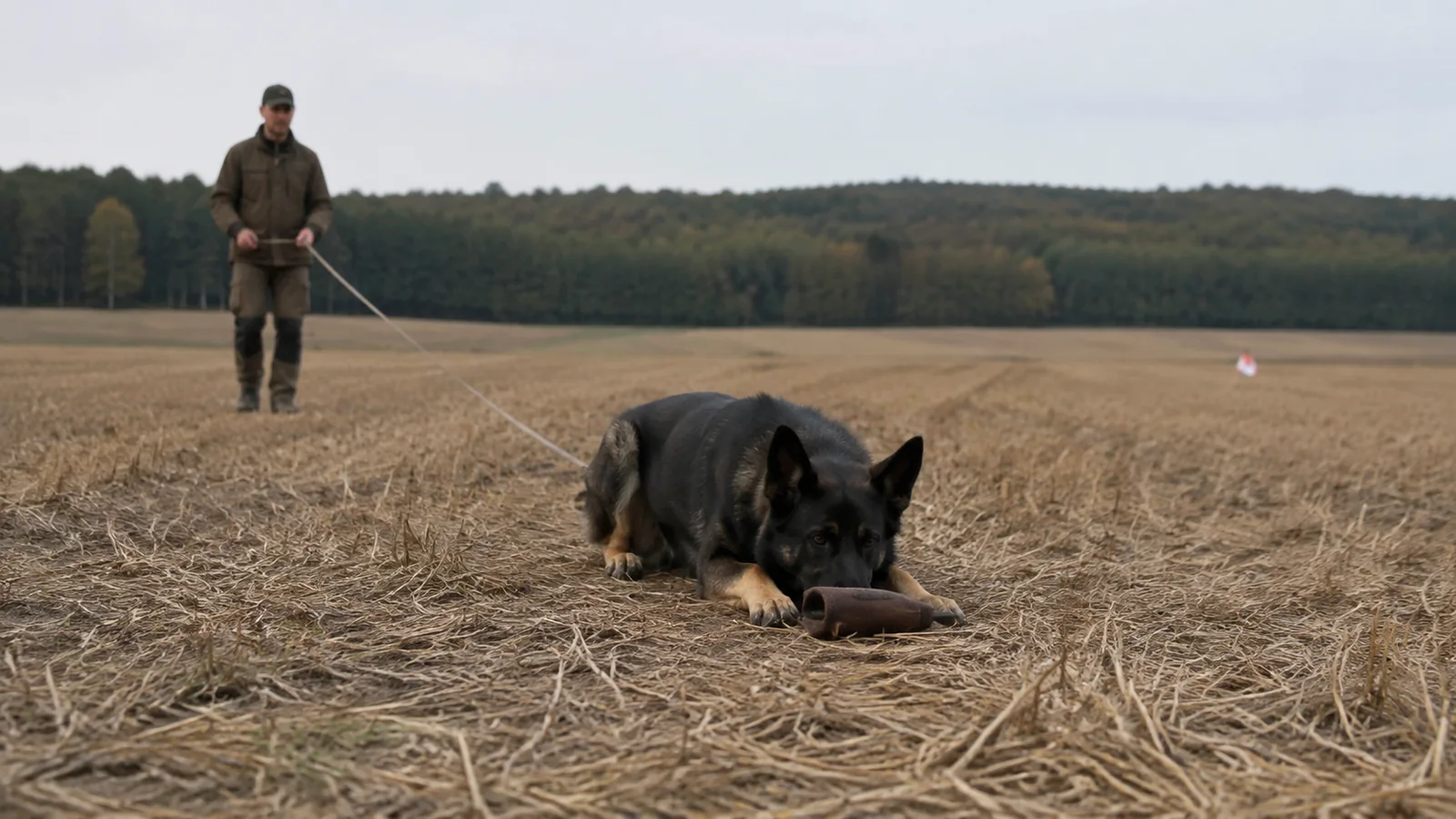
An article is not merely another marker. It asks the dog to move from tracking into a trained indication. Before laying, the handler should know whether indication or picking up is being trained and which response will be reinforced. Material, size and familiarity influence the task. A familiar leather article on short grass is not equivalent to a small textile article on mixed ground. Recording material and position preserves the actual exercise instead of leaving only “article two” in the diary.
Discovery and indication are separate observations
A dog may find an article but indicate it poorly. It may show awareness without moving into the trained position. Discovery status and quality of indication should therefore be recorded separately. A useful note describes what happened: the dog stopped independently, lay down, turned, picked the article up or required help. This detail distinguishes a detection problem from difficulty in the transition to indication or in the handler’s reinforcement. A broad “found” label cannot do that.
Placement changes difficulty
An article immediately after the scent pad, close to a corner or just before the finish combines several tasks. That may be intentional, but it should not happen by accident. On a clear leg, distance from the previous direction change can be understood more easily. Wind, vegetation and visibility also matter. Trial-relevant placement follows the current rules. In training, the position should match the learning objective and be marked while laying so the handler does not unknowingly influence the dog at the wrong spot.
Avoid misleading records
Common documentation mistakes include estimating corners from the map after the session, storing curves as corners and omitting article material or position. The dataset then looks complete while describing a different task. A short timely record is better: mark the element while laying, add actual behaviour while working and leave uncertainty visible. “Not recorded” is more useful than invented precision. Maps should highlight the selected element without silently redefining it.
Turn observations into one next step
A useful review considers conditions and behaviour rather than only counting successful corners and articles. Acute corners may be stable on damp grass while obtuse corners after a long ageing period still need experience. The dog may find every article but require a line cue to indicate. Each pattern suggests a focused exercise. Knurrix connects map elements with their details; the handler and trainer remain responsible for the decision.
Training changes of direction deliberately
A change is easier to understand when only one difficulty is altered. Direction and corner type can remain familiar while ageing time increases moderately; a different surface or crosswind can follow later. An arc needs an even curve and enough distance for the dog to work a genuine progression. An acute corner needs sufficient space for the new line to be laid cleanly. Articles or food placed immediately beside the change may obscure the observation when corner work is the actual focus. The exercise should serve its learning aim rather than collect as many special features as possible.
Observing without rushing to judgement
Watch when the dog recognises the change, how far it checks and whether it establishes the new direction independently. A lateral curve in the recorded route may result from wind or positioning uncertainty and does not automatically prove that the dog overshot. Conversely, a visually tight GPS line cannot show how intensively the dog worked. Handler assistance also belongs in the note. When corner type, direction, conditions and response are recorded across several tracks, stable skills and condition-specific uncertainty become easier to distinguish.
A short documentation routine
Record type, direction and position while laying each change. After the dog works, add where it first responded, what search pattern followed and whether the handler intervened. A photograph or map note can preserve an unusual terrain feature. Choose a genuinely similar task for the next comparison; a right corner on damp grass is not directly equivalent to an arc on dry stubble. If GPS and memory differ, retain the deliberate field marker and acknowledge measurement uncertainty. This routine takes little time but prevents a later analysis from appearing more precise than the original observation. The best record remains honest about what was planned, what was measured and what could actually be seen.